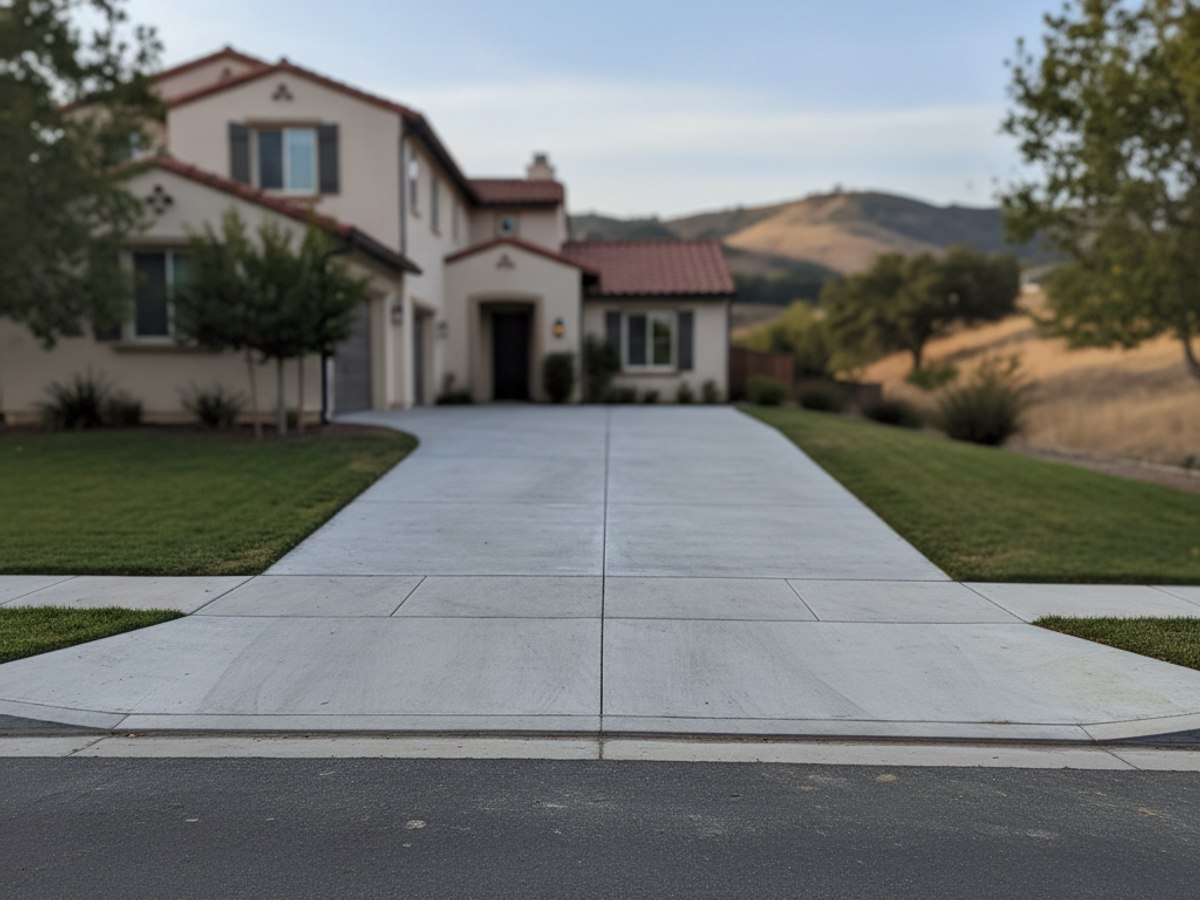
A new driveway or patio in Santa Ana usually looks fine for the first year, no matter who poured it. The problems show up in year two or three, when the base wasn't compacted the way it should have been, or the rebar got left out to save money. By then the guy who took your deposit isn't answering his phone. Concrete is one of the few home projects where the mistake is completely invisible until it isn't, so the hiring decision matters more than it does for something like painting a fence.
Start with the license, not the price
In California, concrete work over $500 in labor and materials has to be done by someone holding a C-8 contractor license through the CSLB. Ask for the license number and check it yourself on the CSLB site rather than trusting a business card. You're checking three things: that it's active, that it's actually classified for concrete, and that there's no history of complaints or a bond claim against it. Also ask about workers' comp if they show up with a crew. If someone gets hurt on your driveway pour and there's no comp coverage behind them, that liability can land on you as the property owner.
A lot of the guys working driveways and patios in Santa Ana are perfectly good tradesmen operating without the paperwork. That doesn't mean they'll do bad work. It means if something goes wrong, you have no license to file a complaint against and no bond to make a claim on.
Read the bid like it's a spec sheet
A real concrete bid should tell you the slab thickness, the base depth, whether it's rebar or wire mesh, and the concrete strength. A standard residential driveway slab runs 4 inches thick over at least 4 inches of compacted class II base rock, sometimes more if the soil underneath is soft. The mix should be at least 3000 PSI, and honestly 3500 PSI is worth the small upcharge on anything that's going to carry a car every day.
Rebar versus mesh matters more than most homeowners realize. Wire mesh gets tossed into the forms and often ends up sitting at the bottom of the pour, doing nothing, because nobody pulled it up into the middle of the slab as the crew poured over it. Half-inch rebar, tied on chairs and set on an 18-inch grid, actually stays where it's supposed to and holds the slab together once it starts to crack, which it eventually will. If a bid just says "reinforced" without saying what with, ask.
Control joints matter too. They should get saw-cut within 24 to 48 hours of the pour, spaced roughly every 8 to 10 feet on a 4-inch slab. That's not decoration. It's telling the concrete where to crack before it decides on its own, usually right through the middle of your new patio.
What the ground under Santa Ana actually does
A lot of Santa Ana sits on old Santa Ana River floodplain soil, which means clay and clay loam that swells when it's wet and shrinks when it's dry. That movement is exactly what cracks slabs that were poured on a thin, under-compacted base. Through a normal winter here, from November into March, that ground takes on water and expands. Then July and August bake it dry again. A slab that's only sitting on 2 inches of loose fill instead of properly compacted base is going to telegraph every one of those cycles as a crack line.
Lower-lying lots, especially closer to the river and the flood control channels, can also run a higher water table after a wet winter. That affects how a foundation slab or a footing needs to be prepared and how the grading around a new patio or walkway should slope, generally at least a quarter inch per foot away from the house. A contractor who's poured concrete around here for a while should be able to tell you, without being asked twice, whether your lot needs extra base depth or a different compaction approach before anything gets recommended.
Permits and inspections in this city
The City of Santa Ana requires a building permit for slab foundations and usually for driveways and patios attached to the house, and for a foundation pour there's a rebar inspection before the concrete truck ever shows up. Skipping that inspection isn't a shortcut, it's a gap in the record that can cost you when you go to sell the house. If the new driveway crosses the sidewalk or parkway into the street, that's a separate encroachment permit through the city's public works side, not the same paperwork as the building permit.
If you're in one of the older districts, like Floral Park or French Park, there can also be a design review layer for anything visible from the street, since those are recognized historic neighborhoods. Newer subdivisions on the edges of the city are more likely to have an HOA with its own rules about driveway finish or color, on top of whatever the city requires. Older neighborhoods built in the 1940s through 60s also tend to have things already in the ground that newer subdivisions don't, old sewer laterals, tree roots, sometimes an abandoned water line, and a contractor who's dug in that area before will know to check before the saw or the excavator gets there.
What should make you walk away
- No license number offered, or a number that doesn't match the business name when you look it up.
- A bid that's dramatically lower than everyone else's with no explanation for the gap. Usually it means less base rock, mesh instead of rebar, or a thinner slab than what was actually quoted.
- Insistence on full payment in cash before the work starts.
- No mention of a permit at all for a driveway, patio attached to the house, or any foundation work.
- Pouring straight over an old cracked slab with no discussion of removing it or fixing the base underneath it first.
- Pressure to sign the same day the estimate is given.
None of these by themselves are proof of a bad contractor, but two or three of them together are a pattern worth paying attention to.
Ask how long before you can walk on new concrete and how long before you can park a car on it. A reasonable answer is around 24 to 48 hours for foot traffic and about 7 days before a vehicle, with the slab reaching most of its design strength by 28 days. If someone tells you it's fine to drive on the next day, that's worth a follow-up question. If you're weighing a driveway, a patio, a foundation repair, or anything else in concrete, our concrete contractor work at Valley Concrete Co covers all of it, and we're happy to walk through a bid line by line before you sign anything.